
The KPI kills the indicator: autopsy of a managerial misunderstanding
By exalting KPIs, companies ignore weak signals that are nevertheless crucial. This article shows how to balance primary management and awareness of secondary indicators.
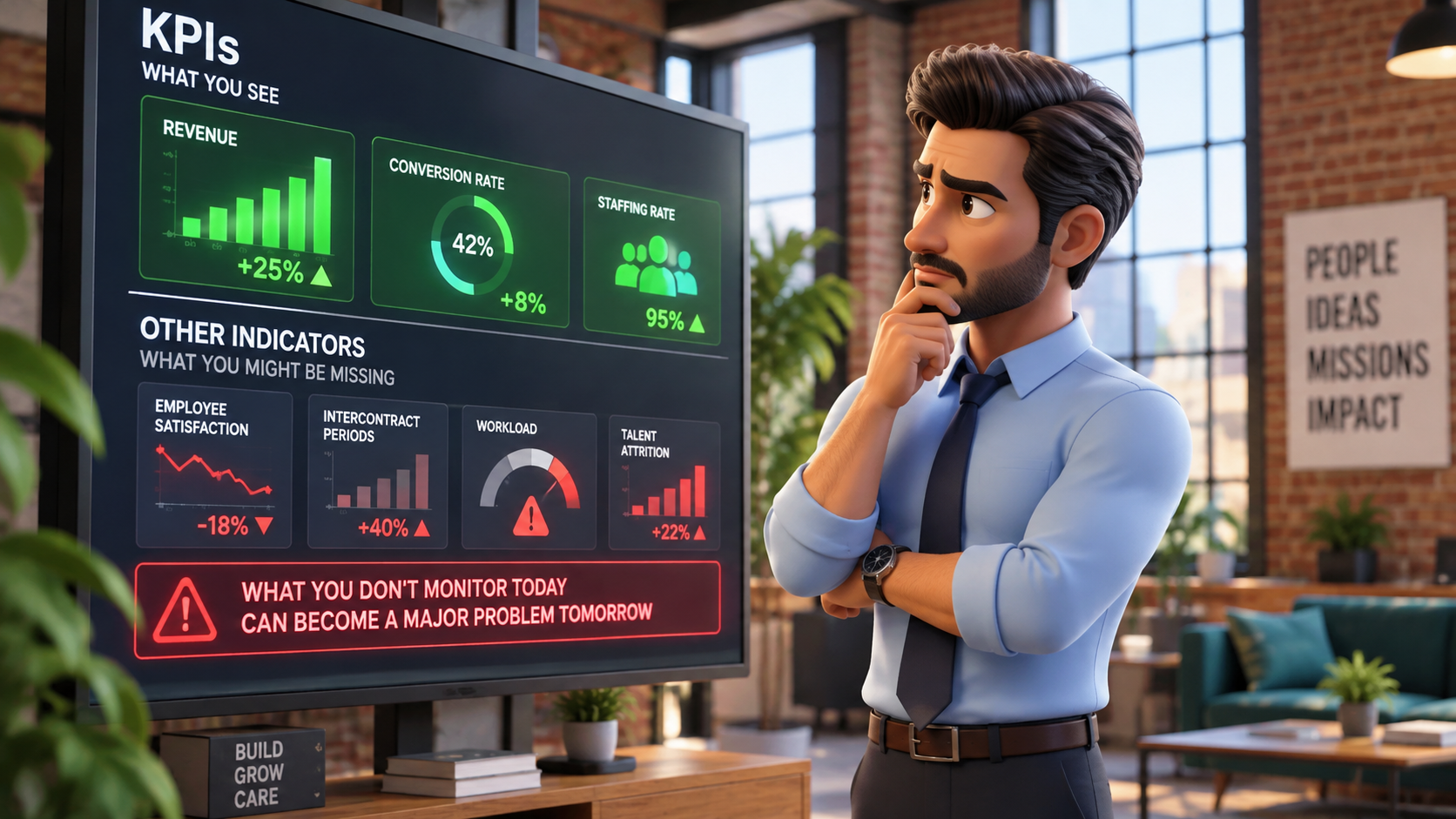
In many companies, KPIs are revered. They dominate reports, feed into executive committees, and become the yardstick for every decision. But by constantly focusing on KPIs, we end up killing what they don't measure.
And that's where the misunderstanding begins.
KPI: the tip of the iceberg
A KPI (Key Performance Indicator) is not a miracle indicator. It's merely a prioritized indicator, at a given time, based on current issues. It's a choice. Not an absolute truth.
But in practice, the KPI often becomes an obsession. We optimize it. We monitor it. Sometimes, we even mask it. And everything that doesn't fall within its scope is overlooked: weak signals, anomalies, non-prioritized indicators, etc.
However, just because we're not looking at a number doesn't mean it isn't telling a story.
What you don't look at can kill you
Imagine a car. You're checking the speed and fuel level. Perfect. These are your driving KPIs.
But one day, the engine warning light comes on. You weren't monitoring it. You hadn't even paid attention to it. Yet, it's the one indicating you risk a breakdown. This light is a secondary indicator. Not a KPI. But it's the one preventing disaster.
In business, it's the same.
You can manage your conversion rates, business volume, staffing rate, etc. But if no one keeps an eye on the internal climate, the evolution of inter-contracts, the overload in HR, or tension on certain expertise areas, you'll end up heading straight into a wall.
The concrete example of an IT services company
A consulting company is experiencing strong growth. The focus is on business KPIs:
- Number of commercial meetings
- Conversion rate
- Signed revenue
Result: the sales teams are under pressure, and they're closing many deals. But in the meantime, another indicator is quietly declining in the background: the satisfaction of consultants. It's not a priority. It's not visible in the dashboard. Yet, in a few months, it becomes a major problem: disengagement, departures, tarnished reputation, missions at risk.
The damage is done.
It's not the quantity, it's the hierarchy
The problem isn't having too many indicators. It's believing that only KPIs matter.
What is needed is a two-tier system:
- Clear, assumed KPIs linked with the current objectives
- And an active monitoring of a set of secondary indicators that can become critical at any moment
This vigilance allows for reactivity, agility, and not steering blindly.
Practically, how to proceed?
- Create a multi-layered dashboard: KPIs at the front, others at the back, but never invisible.
- Set up simple alerts on secondary indicators (deviations, trends, thresholds).
- Establish a monthly analysis ritual to revisit and adjust the KPI list according to the context.
- Train managers to read between the lines and question what is no longer being monitored.
In conclusion
A KPI is a spotlight. It illuminates what you want to see. But by focusing the light too much, you forget what's happening in the shadows.
Crises never arise from the numbers everyone is watching. They arise from those forgotten.
So no, the problem isn't having too many indicators. The real problem is not allowing them the space to exist in the face of omnipotent KPIs.
And your organization, where does it stand?
The CoAct diagnostic allows evaluating your onboarding in five dimensions.